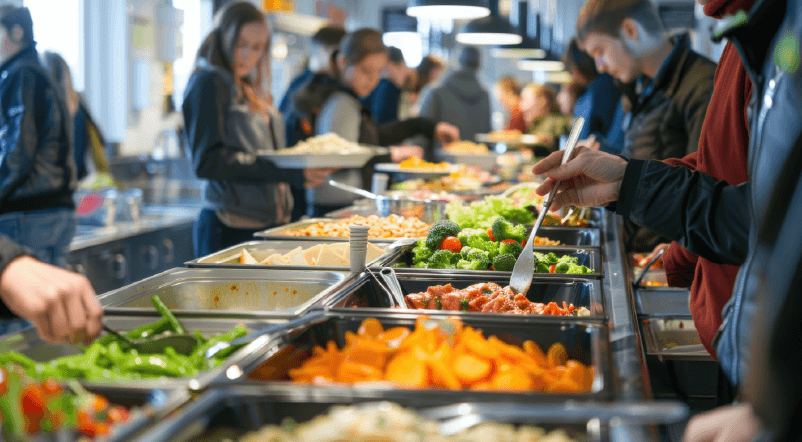

Students today, from K-12 to college and universities, have high expectations around their foodservice and dining experiences. Selecting the right kitchen equipment and supplies can help satisfy expectations. It also can set everyone – students and faculty – up for success.
Key takeaways:
- Schools must cater to diverse dietary needs and preferences while ensuring food safety.
- Streamlining operations through smart equipment with remote monitoring and control can boost efficiency and reduce labor costs.
- Offering grab-and-go options and off-premise dining is essential for convenience and flexibility in ordering methods.
- The NAFEM Show is the show for educational foodservice professionals to explore their options and find the right E&S to equip their facilities.
- Investing in multi-functional equipment, advanced sanitation solutions and energy-efficient appliances can maximize resources and operational costs.
According to the School Nutrition Association, 54 percent of schools have upgraded their kitchen equipment to improve meal quality over the past five years. From tapping into evolving student preferences to unlocking efficiencies and cost savings, read on for what to consider when exploring foodservice solutions across all educational environments.
Consideration 1: Gen Z and Alpha generations
As a more ethnically diverse and digital-first generation, today’s students are driving demand for personalized meal options and enhanced dining experiences. They crave fresher, locally sourced ingredients and plant-based options. They hunger for cultural and global flavors with menus that are as diverse as they are. They also appreciate more tech-savvy operations and sometimes even seek out operations prioritizing sustainable and modern practices.
For Gen Z specifically, value is still a priority. However, value is defined beyond price, focusing on quality, creativity and sustainability.
Solutions to consider
- Salad bars and build-your-own meal stations: Cater to diverse student preferences with customizable food stations.
- Combi ovens: Allow for expanded menus without needing an expanded footprint thanks to multiple cooking functions.
- Self-service kiosks and mobile ordering: Enhance convenience and reduce wait times while appealing to digital natives.
Consideration 2: Dietary needs and preferences
Amid rising concerns about childhood obesity and nutrition, schools must reassess their menus regularly. Catering to diverse dietary needs – such as gluten-free, vegan and allergy-friendly options – has never been more important. Equally vital is ensuring food safety and preventing cross-contamination.
Solutions to consider
- Separate prep stations and storage: Minimize the risk of cross-contamination with different sets of food prep equipment and supplies.
- Advanced sanitation equipment: Ensure thorough cleaning and compliance. See consideration 6: food safety.
- Food storage and labeling: Clearly mark foods to meet various dietary restrictions with color-coded food storage lids.
Consideration 3: Operational efficiency
With increasing costs and staff shortages, streamlining operations and reducing labor costs is critical. Adopting intelligent kitchen equipment with remote monitoring and control functionality can boost efficiency, optimize energy use, reduce waste and improve food safety.
Solutions to consider
- Smart equipment: Allow for remote monitoring and control with IoT-integrated appliances, programmable features and intelligent temperature sensors.
- Automated cooking and food prep stations: Speed up preparation times and reduce labor costs.
- Smart scales and portion control devices: Maintain consistency and reduce waste.
Consideration 4: Grab-and-go and off-premise
Today’s students need to be able to pick up meals for dining in classrooms, residence halls, quads and campus centers. Beyond speed and convenience, they also appreciate flexibility in serving locations and ordering methods.
Solutions to consider
- Market-style grab-and-go centers: Convert traditional dining spaces to market-style centers.
- Food lockers and holding cabinets: Keep delivery and takeaway meals at the right temperature with temperature-controlled holding equipment or display warmers.
- Batch-cooking equipment: Use blast and tumble chillers, hot-water baths and all-in-one tanks for efficient food prep.
Consideration 5: Versatility and multitasking
School kitchens often face space constraints and budget limitations. Multitasking equipment that can perform various cooking tasks is essential, reducing the need for multiple single-purpose appliances.
Solutions to consider
- Multitasking equipment: Offer a variety of cooking methods in one appliance with multi-functional food processors, conveyor ovens, multi-cook ovens and more.
- Modular systems: Adapt to different cooking needs and save space by leveraging countertops or smart storage.
Consideration 6: Food safety
With increasing regulations and the need to prevent foodborne illnesses, investing in advanced sanitation equipment is crucial for schools.
Solutions to consider
- Warewashing solutions: Ensure thorough cleaning and sanitation with different options like high temp, low temp and dual sanitizing machines.
- UV sanitation systems: Provide additional protection against pathogens.
Consideration 7: Sustainability
According to Energy Star, K-12 school districts nationwide spend over $8 billion annually on energy costs. More than 30 percent of those costs go to waste. To combat this, schools and universities are increasingly choosing energy-efficient appliances, compostable utensils and eco-friendly solutions. Enhancing energy efficiency not only saves money and resources but is also appealing to older students.
Solutions to consider
- Ventless cooking equipment: Reduce waste while also lowering operating costs.
- Foodservice technology: Track usage and identify areas for improvement with smart appliances.
Discover What’s Next at The NAFEM Show
Explore the top foodservice equipment and supplies for educational foodservice – so you know what’s really worth the investment for your students – only at The NAFEM Show.
This article includes compiled information from various sources:
“5 Gen Z Food Trends Shaping College Dining in 2024”, US Foods, 2024
“State of K-12 foodservice: Full 2023 survey results”, Foodservice Director, 2023
“2023 School Nutrition Trends Report”, School Nutrition Association, 2023
“School Meal Statistics”, School Nutrition Association, 2024
“Updates to the School Nutrition Standards”, U.S. Department of Agriculture (USDA), 2024
“Food Safety Modernization Act (FSMA)”, U.S. Food & Drug Administration (FDA)
“K-12 Schools”, Energy Star
“Colleges and Universities”, Energy Star
Students today, from K-12 to college and universities, have high expectations around their foodservice and dining experiences. Selecting the right kitchen equipment and supplies can help satisfy expectations. It also can set everyone – students and faculty – up for success.
Key takeaways:
- Schools must cater to diverse dietary needs and preferences while ensuring food safety.
- Streamlining operations through smart equipment with remote monitoring and control can boost efficiency and reduce labor costs.
- Offering grab-and-go options and off-premise dining is essential for convenience and flexibility in ordering methods.
- Investing in multi-functional equipment, advanced sanitation solutions and energy-efficient appliances can maximize resources and operational costs.
- The NAFEM Show is the show for educational foodservice professionals to explore their options and find the right E&S to equip their facilities.
According to the School Nutrition Association, 54 percent of schools have upgraded their kitchen equipment to improve meal quality over the past five years. From tapping into evolving student preferences to unlocking efficiencies and cost savings, read on for what to consider when exploring foodservice solutions across all educational environments.
Consideration 1: Gen Z and Alpha generations
As a more ethnically diverse and digital-first generation, today’s students are driving demand for personalized meal options and enhanced dining experiences. They crave fresher, locally sourced ingredients and plant-based options. They hunger for cultural and global flavors with menus that are as diverse as they are. They also appreciate more tech-savvy operations and sometimes even seek out operations prioritizing sustainable and modern practices.
For Gen Z specifically, value is still a priority. However, value is defined beyond price, focusing on quality, creativity and sustainability.
Solutions to consider
- Salad bars and build-your-own meal stations: Cater to diverse student preferences with customizable food stations.
- Combi ovens: Allow for expanded menus without needing an expanded footprint thanks to multiple cooking functions.
- Self-service kiosks and mobile ordering: Enhance convenience and reduce wait times while appealing to digital natives.
Consideration 2: Dietary needs and preferences
Amid rising concerns about childhood obesity and nutrition, schools must reassess their menus regularly. Catering to diverse dietary needs – such as gluten-free, vegan and allergy-friendly options – has never been more important. Equally vital is ensuring food safety and preventing cross-contamination.
Solutions to consider
- Separate prep stations and storage: Minimize the risk of cross-contamination with different sets of food prep equipment and supplies.
- Advanced sanitation equipment: Ensure thorough cleaning and compliance. See consideration 6: food safety.
- Food storage and labeling: Clearly mark foods to meet various dietary restrictions with color-coded food storage lids.
Consideration 3: Operational efficiency
With increasing costs and staff shortages, streamlining operations and reducing labor costs is critical. Adopting intelligent kitchen equipment with remote monitoring and control functionality can boost efficiency, optimize energy use, reduce waste and improve food safety.
Solutions to consider
- Smart equipment: Allow for remote monitoring and control with IoT-integrated appliances, programmable features and intelligent temperature sensors.
- Automated cooking and food prep stations: Speed up preparation times and reduce labor costs.
- Smart scales and portion control devices: Maintain consistency and reduce waste.
Consideration 4: Grab-and-go and off-premise
Today’s students need to be able to pick up meals for dining in classrooms, residence halls, quads and campus centers. Beyond speed and convenience, they also appreciate flexibility in serving locations and ordering methods.
Solutions to consider
- Market-style grab-and-go centers: Convert traditional dining spaces to market-style centers.
- Food lockers and holding cabinets: Keep delivery and takeaway meals at the right temperature with temperature-controlled holding equipment or display warmers.
- Batch-cooking equipment: Use blast and tumble chillers, hot-water baths and all-in-one tanks for efficient food prep.
Consideration 5: Versatility and multitasking
School kitchens often face space constraints and budget limitations. Multitasking equipment that can perform various cooking tasks is essential, reducing the need for multiple single-purpose appliances.
Solutions to consider
- Multitasking equipment: Offer a variety of cooking methods in one appliance with multi-functional food processors, conveyor ovens, multi-cook ovens and more.
- Modular systems: Adapt to different cooking needs and save space by leveraging countertops or smart storage.
Consideration 6: Food safety
With increasing regulations and the need to prevent foodborne illnesses, investing in advanced sanitation equipment is crucial for schools.
Solutions to consider
- Warewashing solutions: Ensure thorough cleaning and sanitation with different options like high temp, low temp and dual sanitizing machines.
- UV sanitation systems: Provide additional protection against pathogens.
Consideration 7: Sustainability
According to Energy Star, K-12 school districts nationwide spend over $8 billion annually on energy costs. More than 30 percent of those costs go to waste. To combat this, schools and universities are increasingly choosing energy-efficient appliances, compostable utensils and eco-friendly solutions. Enhancing energy efficiency not only saves money and resources but is also appealing to older students.
Solutions to consider
- Ventless cooking equipment: Reduce waste while also lowering operating costs.
- Foodservice technology: Track usage and identify areas for improvement with smart appliances.
Find your WOW at The NAFEM Show!
Explore the top foodservice equipment and supplies for educational foodservice – so you know what’s really worth the investment for your students – only at The NAFEM Show.
This article includes compiled information from various sources:
“5 Gen Z Food Trends Shaping College Dining in 2024”, US Foods, 2024
“State of K-12 foodservice: Full 2023 survey results”, Foodservice Director, 2023
“2023 School Nutrition Trends Report”, School Nutrition Association, 2023
“School Meal Statistics”, School Nutrition Association, 2024
“Updates to the School Nutrition Standards”, U.S. Department of Agriculture (USDA), 2024
“Food Safety Modernization Act (FSMA)”, U.S. Food & Drug Administration (FDA)
“K-12 Schools”, Energy Star
“Colleges and Universities”, Energy Star